There is increasing interest in education in finding new languages for how we understand and engage with the world. Scholars such as Barad, Braidotti, Ingold and Haraway have each, in different ways, invited us to reconsider the language through which relationships between humans, other species, materials and environments are understood. This raises an interesting challenge for education: how might we learn from the broad spectrum of nature stories and non-Western ways of knowing without reducing these to soft anthropomorphism or cultural tokenism?
Finding different words matters because language does more than describe the world. It can alter what becomes perceptible within it. New lexicons can support different models of cognition and learning, mobilising action and thoughtful engagement (Golańska & Kronenberg, 2019). Stories become particularly powerful here. They can introduce unfamiliar ways of thinking and redirect attention, enlivening the places and spaces in which learning occurs and creating possibilities for learning that feels more vital, resonant and energetic.
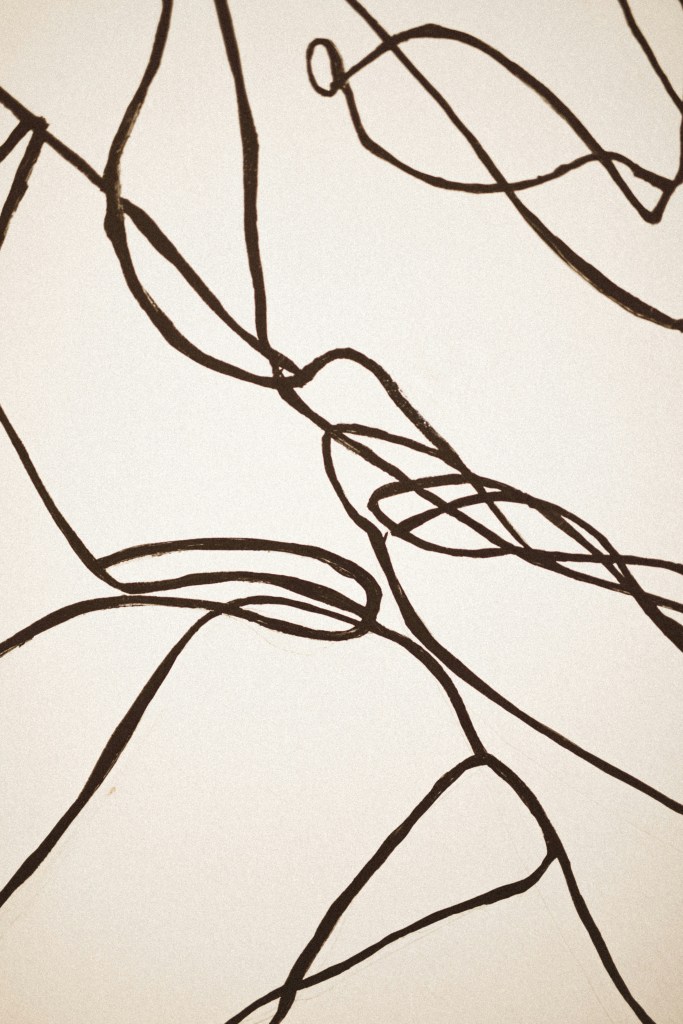
Perhaps new stories allow education to emerge along new lines. Ingold (2004) has written extensively about lines and the ways lives unfold along them. These lines are neither neat nor straight; after all, a beautiful line is never straight. Lines overlap, tangle, wander and break free from conventional paths. There is something of Deleuze and Guattari’s rhizome here too: movement that does not necessarily proceed predictably from one point to another, but branches, connects and escapes.
I wonder whether education might become more comfortable with such lines. Our anthropocentric and colonial histories have handed down particular paths for understanding the world, and these cannot simply be erased. Nor should they be. Perhaps, instead, we might sometimes blur what appears certain, like an artist squinting to see a new perspective. Squinting does not make what is already there disappear. It alters the field of vision just enough for different shapes, relations and possibilities to become noticeable.
This kind of knowing asks for attentiveness, empathy and a softness towards knowing otherwise. It means lingering in places long enough to notice difference and accepting that those who wander are not necessarily lost. What emerges may be neither right nor wrong, but different: perhaps a new line, perhaps an old line grown dim through industrial ways of living and knowing. By becoming receptive to other ways of knowing, sensing and being, might we begin to move differently in relation to the world—to notice its rhythms, pulses, vitality and resonance, while remembering that we ourselves are also alive?
These lines may have become difficult to see, but perhaps they remain available if we pause long enough to notice them. Lingering in uncertainty need not signal an absence of knowledge. It might instead describe an openness through which other relations and possibilities become perceptible. Haraway’s (2007) thinking around becoming-with and Kimmerer’s (2017) reminder that all flourishing is mutual offer ways of considering what such relations might make possible.
There is something here that I think of as a technology of seeing. It may awaken curiosity in some and suspicion in others. Education is, after all, increasingly accustomed to predetermined structures, measurable outcomes and performative ways of demonstrating what is known. Remaining with uncertainty takes time. Challenging what we think we know takes time too. Perhaps this is precisely why creating educational spaces in which different ways of seeing can emerge matters.
Changing the world demands not only changing the way we see it, but also changing the way we experience and engage with it. Here, the observer and observed become less easily separated. Abram (1996) offers a way of thinking about perception in which human and more-than-human worlds can be encountered with an intensity and nuance not always acknowledged within Western traditions. Related ideas appear across different philosophical traditions: in Deleuze and Guattari, Stengers’ ‘ecology of practices’, Haraway’s ‘becoming-with’, and Massumi’s ‘belonging-together’. While their languages differ, each creates an opportunity to reconsider ourselves not as detached observers of a world outside us, but as participants within relations already underway.
Perhaps this is one possibility for education: not another method or framework to impose upon learning, but an invitation to notice the lines already moving around and through us—and to remain curious about where they might lead.
Until next time, Dr Mon. x
Abram, D. (1996). The spell of the sensuous: Perception and language in a more-than-human world. Pantheon Books.
Barad, K. (2003). Posthumanist performativity: Toward an understanding of how matter comes to matter. Signs: Journal of Women in Culture and Society, 28(3), 801–831.
Braidotti, R. (2019). Posthuman knowledge. Polity.
Deleuze, G., & Guattari, F. (1987). A thousand plateaus: Capitalism and schizophrenia (B. Massumi, Trans.). University of Minnesota Press.
Haraway, D. J. (2007). When species meet. University of Minnesota Press.
Ingold, T. (2007). Lines: A brief history. Routledge.
Kimmerer, R. W. (2013). Braiding sweetgrass: Indigenous wisdom, scientific knowledge and the teachings of plants. Milkweed Editions.
Massumi, B. (2015). Politics of affect. Polity.
Stengers, I. (2005). Introductory notes on an ecology of practices. Cultural Studies Review, 11(1), 183–196.


Leave a Reply