We are living in a moment where machines are increasingly capable of telling stories.
These storytelling platforms, such as ChatGPT, mimic the themes we are interested in and attempt to match our tone.
But the discussion I raise today is not the risk that machines are good at telling stories, but the risk that we stop telling our own. That is, we are gently, ever so softly, over the years to come, eroded of the confidence in our own ability to make and communicate meaning from our lived experience and doing bodies.
Ben Okri (1997) once wrote:
In a fractured age where cynicism is God, here is a possible hearsay: we live by stories; we also live in them . . . If we change the stories we live by, quite possibly, we change our lives.
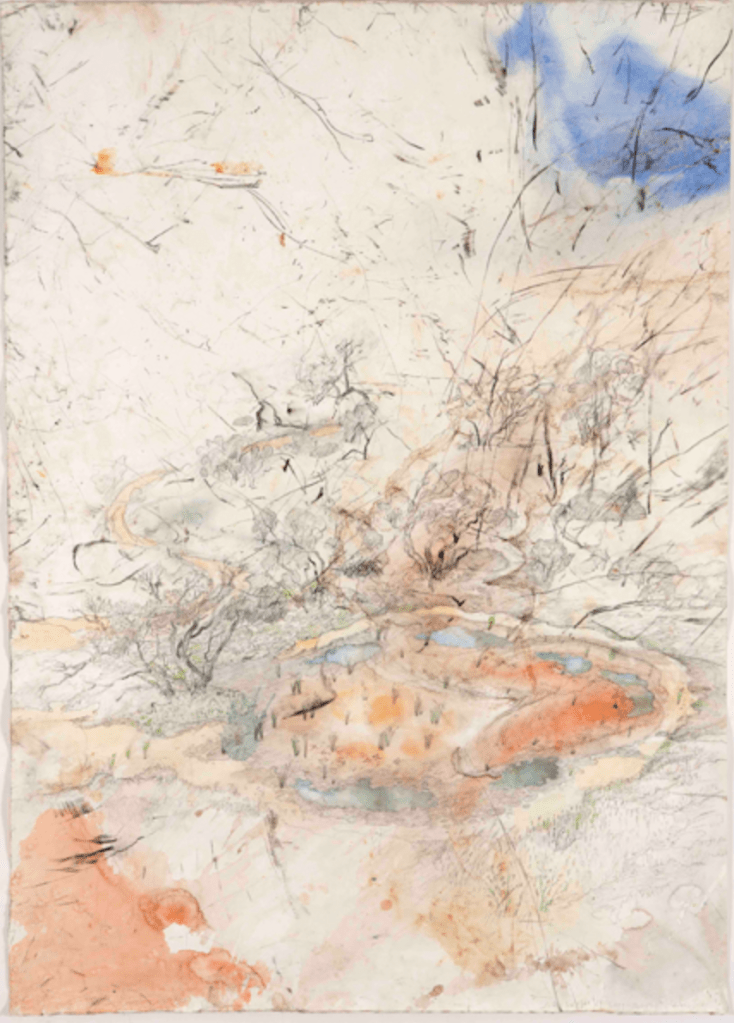
This presentation centres on Teddy—a pseudonym for an academic, an educator, and an Australian visual artist of international standing.
In this presentation, I use his data intentionally to consider the role of storytelling in today’s age. I consider how the stories we choose to tell, and how we tell them, can define our own sense of becoming.
I focus on becoming through the work of Deleuze and Guattari as a power of life, an agentic force that has no end but supports ongoing actions within our worlds. Deleuze refers to distinct tendencies of becoming—the becoming of animals, the becoming of plants, the becoming of human bodies, and even the becoming of philosophy and art.
As a summary, Deleuze and Guattari’s work was geared towards understanding how difference emerges. Thus, a human body (or animal, plant body) and its essences are not what it is, but its ability to perceive and act upon that perception.
Through this understanding, life is a series of divergent possibilities which actualise worlds. And via such understanding, the self is always in the making.
The data I share today via a story as a portrait was developed and illuminated from my visit to Teddy’s place of work in the Victorian bushland.
Through portraiture as a method, a qualitative research design developed by Sarah Lawrence-Lightfoot (1997) in the 90s, the task is not simply to record information but, like a portrait painter, to attend to gestures, context, and participant nuance as means to illuminate details that can provide insights often unnoticed or discarded.
The story to follow and the themes I explore today are drawn from my interview with Teddy and at-work observations. Teddy’s data was initially used as part of a broader study exploring aesthetics and educational practice.
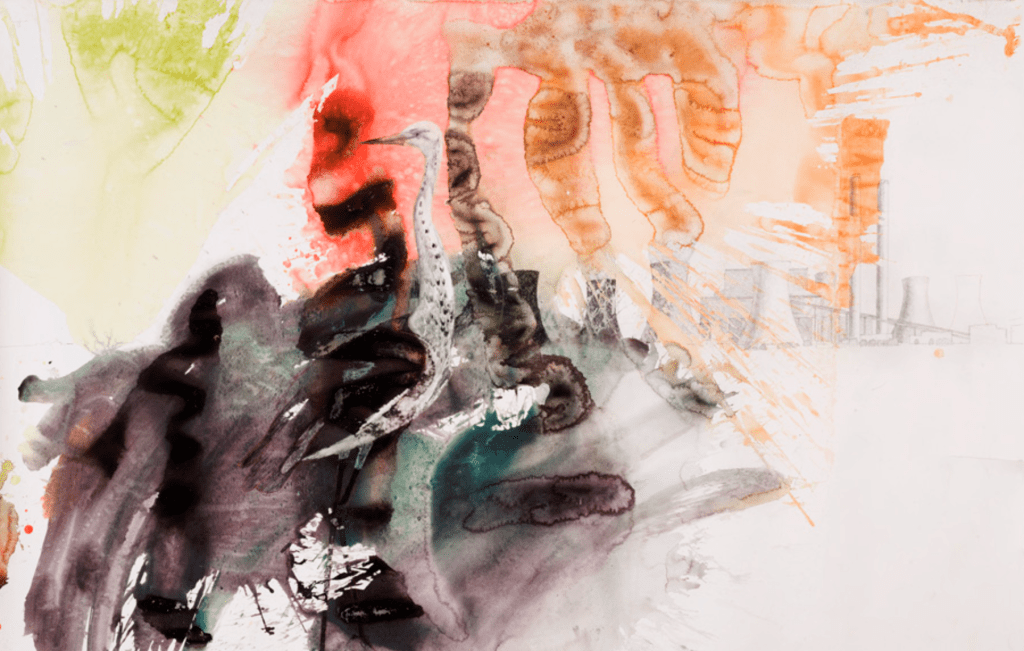
Let’s begin.
Teddy hears my car as I arrive for my interview at his regional property and art studio in the Victorian bushland. He comes to welcome me. At 84 years of age, there is a slight shuffle in his step, his tall, muscular frame feeling the gravitational pull of age. His white hair springs off his head like a series of antennae to record the humidity.
His face is alert, attentive, with gentle eyes and a lopsided grin.
When I enter his large cement art studio, I am presented with a bricolage of Teddy’s world.
Art supplies, books, and necessities are piled on large art tables, adorning the walls and ceilings. Rather than disorder, the studio breeds curiosity and possibility, where, in the pursuit of one object, you may find another.
“I try to pull it back sometimes, but it quickly returns to its primal mass,” Teddy confesses about the studio’s piles of art and abundance.
After a Darjeeling tea, some orange cake, and an introduction to Teddy’s personal and arts-based history (moving from England to the Oz as a young artist in the 60s), we leave the large studio for a walk around the lake.
As we walk, I ask Teddy a question that I have not yet asked since my arrival about an hour and a half ago.
It’s a simple question.
“So, why are you an artist?”
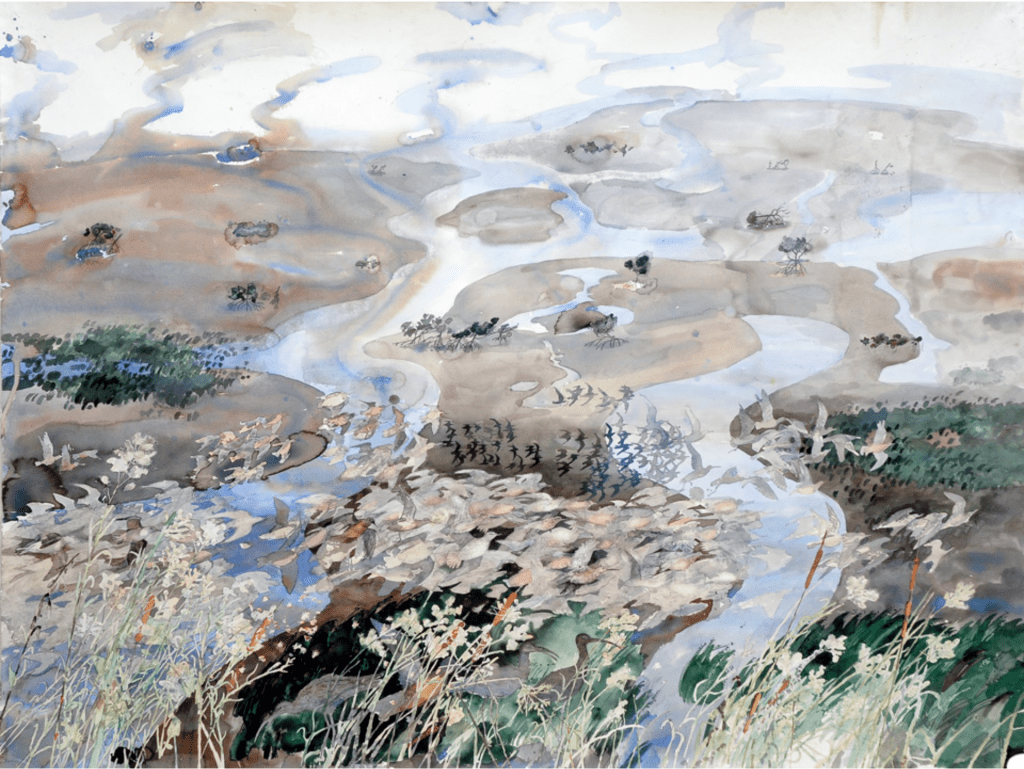
He begins by telling me about a close friend with whom he used to go fly-fishing and bird-watching.
He says:
“Every time we went out, we always had the same conversations. We became who we are to impress our fathers.”
But I thought something about that story didn’t seem to fit.
Earlier, Teddy had described a distant and complicated relationship with his father.
He had spoken about sneaking into his father’s study.
Reading books. Listening to records. And getting in trouble for this.
So I asked him: “Do you think that is true—or is that the story you choose to tell?”
He paused. Turned toward me. Chuckled.
And said: “Well… when you put it that way, I suppose there could be another story.”
As we walk around the lake, another story emerges, a different story from this original one… this time he moves the conversation towards his mother.
Teddy said, “My mother committed suicide when I was about five, and she was with her fourth child; it was very tragic. I can’t remember anything about her, which was some sort of repression, but what was rather amazing is I knew she used to sing Schubert’s songs.”
In this moment, the question of why Teddy became an artist no longer sounded like a matter of tradition and inheritance.
It sounded like searching.
For Teddy, the nature he loved and prioritised within his art was not a backdrop to his lived experience. It was a companion.
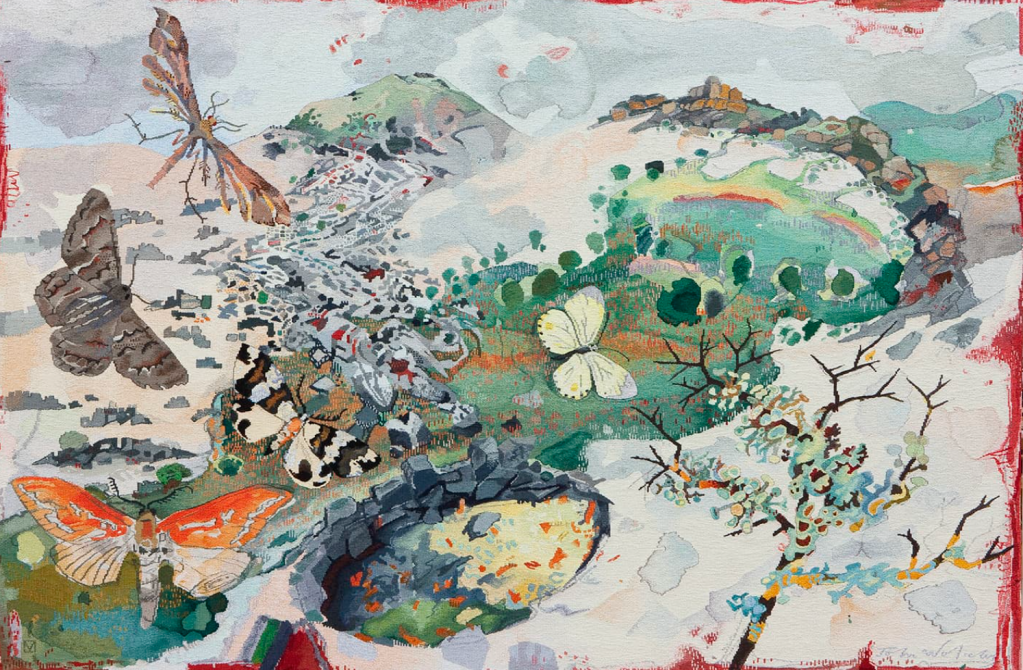
Teddy continued: “I spent a long time looking for my mother in the valley near my home. That’s when I got passionately into lizards and drawing them.”
For Teddy, it was not only about expression but more an orientation towards his own becoming.
A way of making sense of his loss.
A way of staying in and developing through troubled relationships with a world that had become difficult to understand.
Teddy’s connection to his arts-based practice emerged through embodied response.
Teddy put it simply: “I expressed myself through doing in order to make sense of it all.”
Through “gesturing” as a physical expression engaged through his arts-based practice, Teddy is able to “get in tune,” where patterns of truth are revealed. “It is all about luring in the right way, moving authentically,” as Teddy explains.
He continues: “Everyone is a special kind of artist—if they find out what part of them has got that creative thing.”
Teddy, although a visual artist, spoke also about various art practices, including music and poetry. He said, “Someone once asked me what I feel most lucky about—and it is my deep love for poetry, music, art…”
“The common link they share is in their attention to patterns.”
“There is a depth of patterning that, if one is still and attentive enough, one can unlock the poetry from within.”
Teddy believes that teacher education and universities should care about the arts to facilitate such states of attention.
“I am particularly concerned with universities at the moment and their heavy preponderance of rationality,” he explains.
Teddy is not arguing that everyone should become a painter.
He is pointing toward human creative capacity.
Distinct ways of sensing, knowing, and responding.
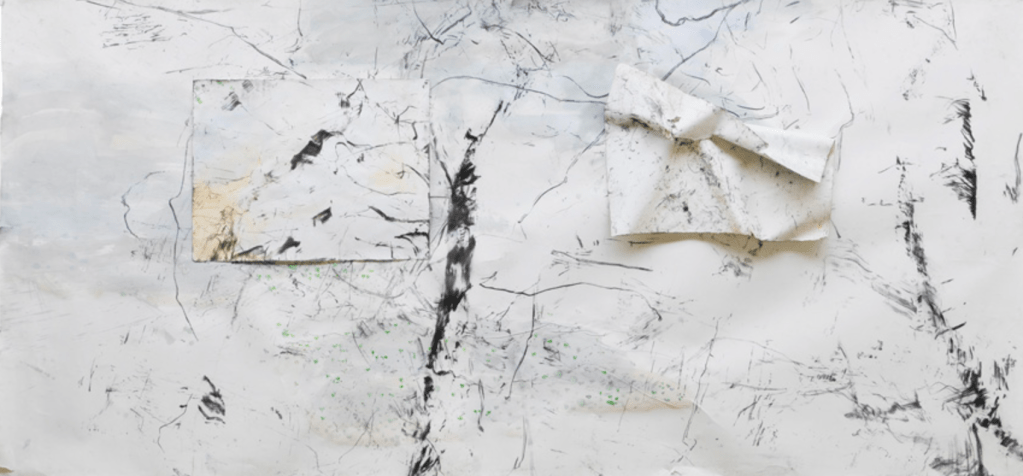
Teddy takes me outside to demonstrate his frottage technique, where he dances with the charcoaled branch of a tree to leave etchings on the page that become embedded within his artwork.
“See, this is much more beautiful than you could do in the studio,” he says. “It is partly aleatoric, but it is related to the Heideggerian ideas . . . where paths are constantly intervened with. As Heidegger (1971) calls it, there is a thrown-ness to being in the world and ‘one responds as best as one can’.”
He is reminded of his first teacher:
“My teacher, when I was 21, always used to go on so much about how you move and that painting is so much about your vehicle and what goes onto the canvas. You are not a God who invents himself; you are a vehicle towards communication . . . as painting is just a tool we use to access this.”
Teddy helps us to understand learning and a search for patterns as attunement. That form of knowing is grounded in embodied attention. “Deep down connections that I can’t do in my head alone.”
As Teddy reflects, he searches for language: “So much to do with flight… or passage… or rites of passage… lines of flight… something like that.”
“It is about the head, heart, and hand . . . have you heard of this?”
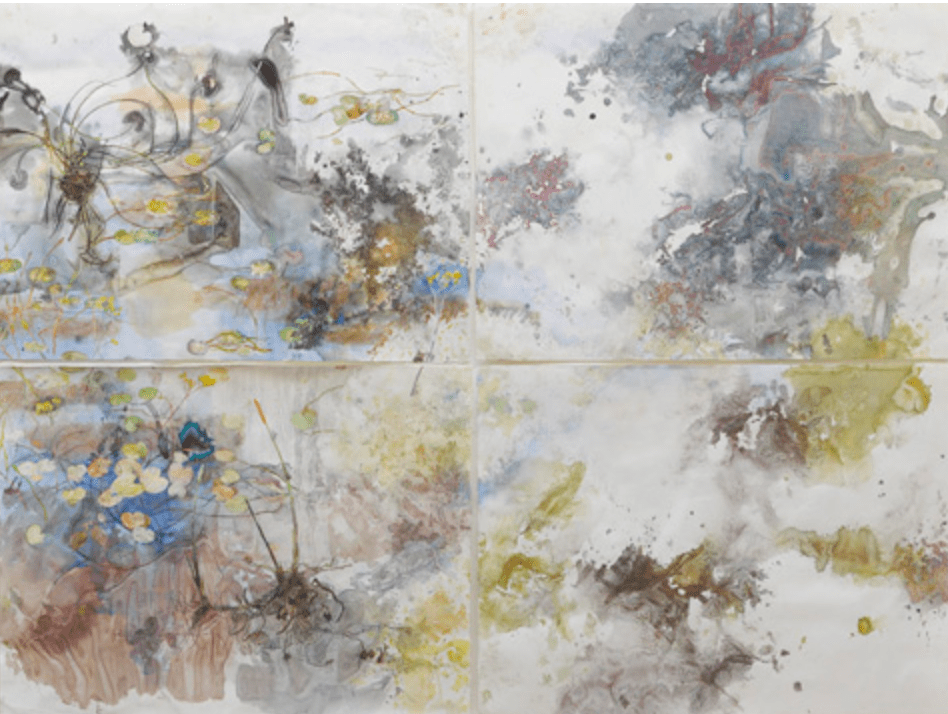
Although I could continue with Teddy’s stories, let’s pause now and focus on Lines of Flight.
Although not referenced directly by Teddy and perhaps acquired in passing or through his love of reading and literature, the phrase “lines of flight,” as a focus of today’s session, aligns with Deleuze and Guattari’s rhizomatic concept.
Lines of flight form a central part of the broader philosophy in Deleuze and Guattari’s (2004) text A Thousand Plateaus, which rejects static identities and fixed structures.
Lines of flight represent a force that breaks free from constraints.
Lines of flight describe a dynamic and productive concept. These lines signify creative escape routes from rigid formations. As the line of flight moves, it reconfigures and redefines itself, responding to the flow of life and the specific conditions of time and place. It offers a mode of existence that is continuously evolving, shaping itself through engagement with the world and others.
By this definition, fixed categories and classifications are undone in favour of exploration, experimentation, and transformation, creating new spaces for freedom, expression, and possibility.
As Deleuze explains, becoming does not extend along a single line; rather, there are thousands of plateaus, planes of different durations.
In their original French texts, “flight” and “escape” for Deleuze and Guattari both translate as fuite, which has a different range of meaning than either English term. Fuite covers not only the act of fleeing or eluding, but also flowing, leaking, and disappearing into the distance. The vanishing point in a painting is a point de fuite. It has no relation to flying, really.
Lines of flight, as a construct, are a call to break free from the constraints of the familiar and explore the infinite potential for reinvention that lies beyond established norms.
Deleuze argues that all thinking ought to be creative. By acting upon thinking through arts-based inquiry, we create ourselves along the way, no longer simply accepting values and assumptions.
In education, with the prolific expansion of AI opportunities, we are surrounded by powerful stories about what teaching, and consequently, teachers, should look like: efficient, adaptive, and productive. And increasingly, these stories are shaped by automatic technology.
And in this kind of world, reflection becomes harder. Stories become thinner. And when this happens, the future becomes more difficult to imagine, the past more difficult to interpret.
Because while machines may increasingly generate stories, education remains concerned with how humans live them.
So perhaps the question is not simply what AI can do for us.
But what teacher-researchers must continue to do.
If teacher education remains a place where stories can be told through expansive platforms, questioned, revised, and lived, where embodied knowing still matters, where arts-based experience helps us attend to the world, then teacher education remains a place where becoming otherwise is still possible, where we value and make sense of our lived world through story sharing and the arts.
With a priority on narrative inquiry, as presented today, lived experience is placed at the centre of discourse, embracing one’s biography rather than sidelining it as a means of influencing meaning-making.
Arts-based practices hold a mirror up to who we really are, exposing stories that celebrate rather than strip our own lived experiences as ongoing states of becoming and emergence.
Teddy’s story reminds us that not all knowledge arrives that way.
Knowledge emerges slowly.
Through making.
Through uncertainty.
Through aesthetic encounters with the arts.
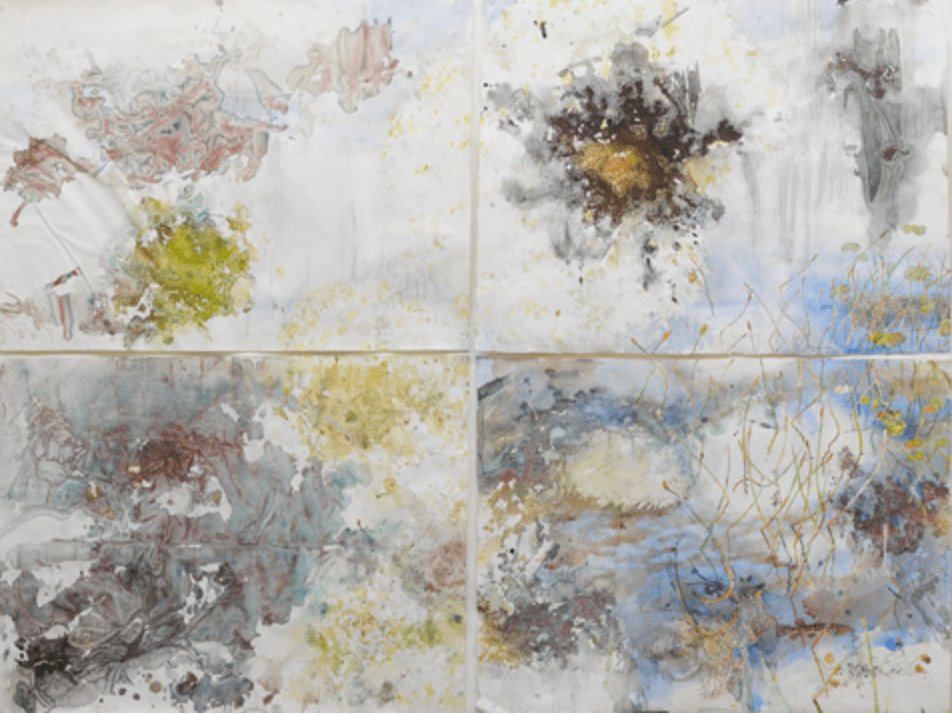
When we strengthen our own self as our multifarious, gestural, fluid, evolving self, we begin to see this self more clearly despite its complexity—we embrace more intentionally our embodied, lived, and experiential being.
We look to use this multiplicity of language with purpose.
We reclaim our becoming through taking time to tell our own stories via arts-based means.
And in turn resist losing ourselves to the wash of daily life, where technology is at our every whim.
Teddy’s data reminds us that the telling of stories creates ruptures where new stories can emerge.
As Haraway (2016) states: It matters what matters we use to think other matters with; it matters what stories we tell to tell other stories with… It matters what stories make worlds, what worlds make stories (p. 12).
So I return to where I began.
Machines may increasingly tell stories.
But teacher education must remain a place where humans learn to tell—and re-tell—their own.
I ask you to consider: what stories do you tell, and how do you tell them?
Think to yourself—what currently defines your storytelling, and do you think this is the complete story? What are new ways you could genuinely forge new senses of becoming through the stories you choose to tell?
How could you express these stories beyond the written word alone?
Reference List
Deleuze, G., & Guattari, F. (2004). A thousand plateaus: Capitalism and schizophrenia (B. Massumi, Trans.). Continuum. (Original work published 1980)
Haraway, D. J. (2016). Staying with the trouble: Making kin in the Chthulucene. Duke University Press.
Heidegger, M. (1971). Poetry, language, thought (A. Hofstadter, Trans.). Harper & Row.
Lawrence-Lightfoot, S., & Davis, J. H. (1997). The art and science of portraiture. Jossey-Bass.
Okri, B. (1997). A way of being free. Phoenix House.
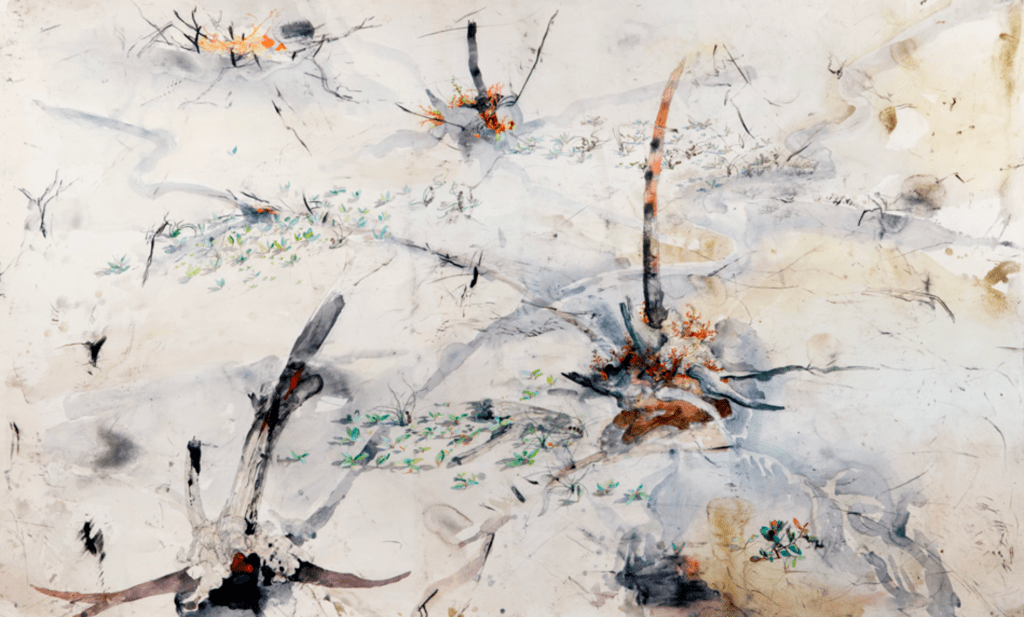
Images: https://johnwolseley.net/exhibitions/john-wolseley-heartlands-and-headwaters
The Visual Art Stimulus included as part of this presentation was created by: https://www.birdwingsforestschool.com/
Jennifer McCormack and Narell Neville are Directors of Birdwings Forest School, the Gold Coast’s first award-winning Forest School, offering nature connection programs for children and families on Kombumerri Country. Their collaboration is sincerely thanked as we look to research that engages knowledge sharing beyond the confines of the written word alone.


Leave a Reply