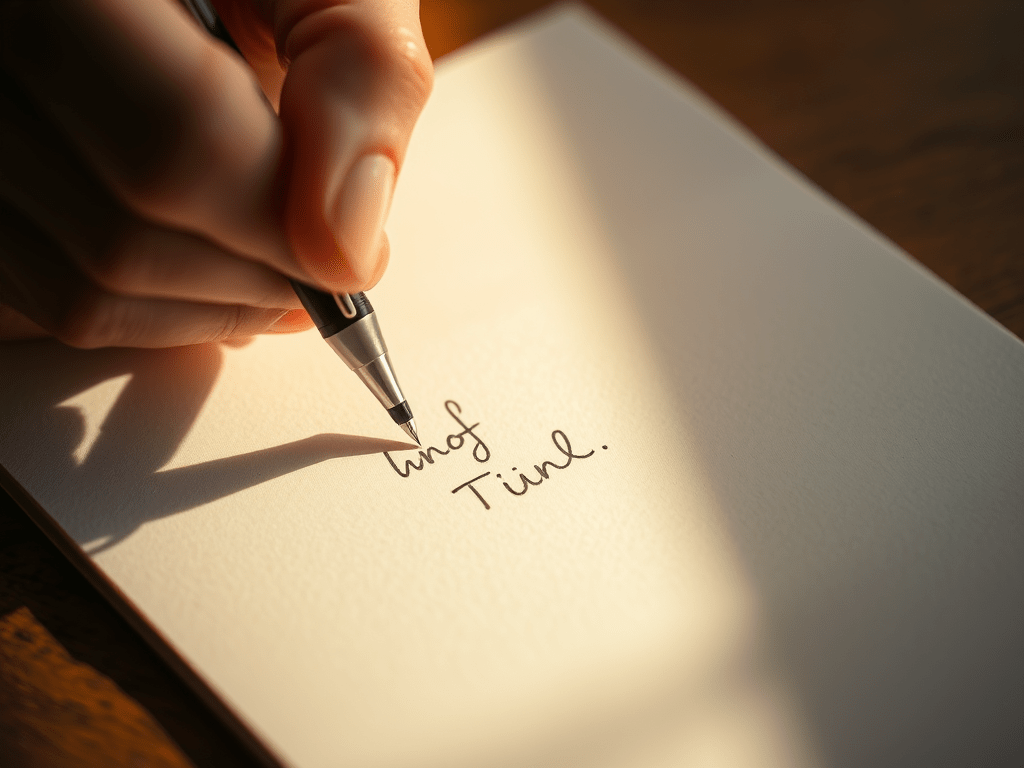
The need to write—to form our symbols of language on the page, to engage with the written form of a language we also express through speech—is deeply human. Writing is like the presence of our tongue in our mouth. To press our fingers to the page, to feel the weight of the pen, to use this tool to craft a method of connection with others and the world, is to leave a legacy not only of ourselves, but of something uniquely human.
Writing as Human Expression
Though I’ve written before about the importance of materials in writing, it’s the skill acquired through practice that gives rise to something more profound. Writing offers a space where our generative and imaginative minds can remember a past and envision a future. This process is uniquely human.
As I press my pen to the page—or my fingertips to the keyboard—I am writing words that share ideas. And it is this ability to create and express ideas that defines my individuality. The way I see the world—the colours, shapes, the sounds I hear, the things I notice, the places my imagination wanders—is mine alone. Even more unique than my DNA, it is the entanglement of neural firings and lived experience that makes my ideas ever-changing, new, and distinct.
To write is to say:
This is me. I think. This is me. These are my ideas.
Rhythm, Structure, and the Mind
When we write, letters move across the page from left to right. This movement carries a rhythmic energy, and our minds travel along with it. Without writing, our thoughts may spiral irregularly, lying dormant within. Writing gives our ideas shape, rhythm, and structure.
In this way, writing resembles speech—but it also stands apart. Writing is not a conversation with another person; it is a dialogue between the self and the page. It is a monistic entanglement of self with self, rather than with others.
That’s why writing can be such a genuine form of expression. In writing, we are not influenced by our company or surroundings. We are alone, even in a crowded room, and the ideas we express are ours alone.
Why Silent Writing Matters
Yet writing takes time. And in a world full of distractions, finding that time—and focus—is increasingly difficult. Schools, therefore, have a responsibility to provide opportunities for what is called silent writing. These are dedicated moments of stillness where students can practice, develop skill, and give form to their ideas.
The act of handwriting may soon become a kind of artform. As digital tools dominate, the pen and paper still offer essential fine motor development for young learners. Perhaps we don’t need sweeping changes—just thoughtful shifts. For instance, we might introduce touch-typing in Year 5 rather than Year 8, layering it alongside handwriting rather than replacing it.
Since students will switch to digital tools earlier, the quality of writing materials becomes even more important. And as long as exams are handwritten, we must make space throughout a student’s education to maintain those skills. Silent writing, then, isn’t just preparation—it’s practice in honouring an ancient human craft.
Writing as Craft, Identity, and Connection
School is a formula. A style. A set of behaviours inherited from a bygone era. But so long as school exists, we must embrace its components and use them intentionally. If exams require writing with a pen and paper, then we prepare students accordingly—not grudgingly, but with purpose.
We can expose students to different tools and forms of paper, inviting them to fall in love with writing not just as a skill, but as a craft. We teach them that language is symbolic and uniquely human. That writing connects them to their Mother Tongue, their identity, and their sense of belonging.
In Australian schools, we teach English—but we must also offer time for students to write in their Mother Tongue. This honours their heritage and validates their voice. We teach spelling, grammar, and forms—from essays to fiction, biography to autobiography—but most importantly, we teach them to write to share ideas.
It’s not about the polish of presentation. It’s about the depth of thought behind the words.
The Rise of AI and the Value of Slowness
As AI tempts us with its hedonistic simplicity, it can feel easy to let it do the thinking. But some tasks—like writing—require slowness. They require attention. They require the application of skills we’ve worked hard to learn.
Writing should not just be a task. It should be an act that brings nourishment and satisfaction.
And yes—this is not easy.
Writing is a craft. It demands time and mentorship. It takes experienced writers to guide others in the process.
But beyond grammar and spelling—rules AI may soon tidy up for us—lies the human need to share ideas. To maintain our humanity in an increasingly digital world, we must remember: our unique minds are worth sharing.
And we share them through writing.
Until next time,
Mon xx
 EDUCATOR8
Leave a comment